Showing posts with label parenting. Show all posts

Tuesday, May 29, 2007

too bad I can't think of a title

A couple of weeks ago, I took Swee'pea to the mall to buy him his first hard-soled shoes. I wanted to get him a pair of runners and a pair of sandals.

When we got to the children's shoe store, a tiny brown bird was fluttering under some stools. Somehow it had gotten into the mall, and couldn't find its way out again, couldn't make sense of all the bright, treacherous windows of sky that were inexplicably, relentlessly hard.

Some men tried to capture it under the stools, to bring it safely past the sheet glass walls and doors to outside, but the bird suddenly flew up and just over my head. We watched it nearly bang into several windows before it flew deeper into the mall. Eventually, we saw the three men had caught it in a hat, and were taking it outside.

The store clerk measured Swee'pea's feet and pointed out the boys' shoes, immediately writing off the girls' shoes. There was one red pair of girls' sandals that I was really tempted by, but I decided to toe the gender performance line. The day before, I had just read this post about the blogger's 4-year-old son wanting pink sandals and how she didn't get them for him and how she felt bad about that.

My first gut feeling was that I would just buy Swee'pea pink sandals if we were in the same position. But kids' shoes are A LOT more expensive than I expected... almost as expensive as adult shoes. And now that I've been at this mothering gig for more than a year, I know better than to develop a firm opinion about how I would handle a situation down the road. Nevertheless, the question of kids getting teased by other kids, and whether and how and if parents can protect them continues to circle my mind.

When I was 8, my family moved from the suburbs of a small to medium city to a farm outside a tiny village. When I lived in the suburbs, I was a pretty precocious I think. I had a lot of friends, both in my own neighbourhood and at school. I was pretty extroverted and confident. There were people who teased me about my red hair, and I think I accepted that I wasn't pretty, but I was still an interesting person and felt worthy of friendship. I remember being surprised that Jack Tripper on Three's Company had such a thing for redheads, because in my world red hair was ugly. That teasing didn't bother me too much.

When I went to the new school, I got teased and totally ostracized. For months I went home crying every single day. My mom thinks it was because I had been labelled as gifted at my old school that had a program for streaming gifted kids. This new school had no similar program and no real idea what to do with me; but they thought they had to do something with me so they singled me out, took me out of classes and told the kids it was because I was so smart. I suspect my mom is probably right. But maybe my initial confidence in my ability to make friends was also to blame, maybe I came off like some city kid ready to conquer the world. Whatever, the ostracism made me miserable and took me nearly a decade to recover from, nearly a decade before I returned to self-confidence and happiness.

I watched kids get teased for many reasons (and, I am ashamed to say, I teased other kids myself in the hopes that I would be more accepted). One girl was teased for being fat, given a nickname with the word hippo in it, even though she wasn't actually that big, and when she came to high school all skin and bones, she still got teased and ostracized. And I knew other fat kids who were cool, utterly respected.

I am beginning to suspect that some kids are targets no matter what, and the things that get picked on are arbitrary. Kids will find anything to pick on: hair colour, freckles, glasses, braces, weight, nose-picking, whatever.

Every parent wants to protect their kids from harm, psychological or physical. Some months ago, I was at a playgroup and asked how old one boy was. He seemed quite a bit bigger than the others so I figured he must be near three. I think he was just over two though (I can't remember the specific numbers) and the father started telling me about how big his son is, how he's worried that he'll still be big when he starts school and how he'll have to put his son on a diet beforehand if it comes to that. He said, "I don't want my son to be the big kid at school. Kids are cruel and I don't want that for him."

I can't fault his intentions, his desire to protect his son from potential misery. But I'm suspicious that making sure they don't do anything or become anything that might elicit other kids' cruelty may not be the best way to ensure our children's mental health. I'm starting to wonder if maybe it would be better to accept our children as they are: freckled, fat, funny haired, bespectacled, wearing pink sandals or bending other gender rules, passionate about uncool pursuits like stamp-collecting or chess, whatever. If maybe we should give our kids a place where they feel 100 percent safe and accepted and loved, a shelter from the storm of the schoolyard, where they know that who they are is ok, and they just need to survive this time to discover a more accepting world in the future.

I don't know. I don't pretend to have all the answers and I'm sure my ideas will change as soon as Swee'pea approaches school age, but this is what I'm thinking about right now. And it's what I was thinking when I watched Little Miss Sunshine.

(Warning: spoiler ahead... if you have any thoughts about watching this movie, and don't want to know the ending even though it would still be a great movie to watch even knowing the ending, you might want to stop reading now.)

When the Hoover family finally arrives at the Little Miss Sunshine pageant, the dad and the older brother want to remove Olive from the pageant. They watch the shiny baby barbie dolls performing their polished numbers on the stage and recognize that Olive isn't one of them. They're afraid that she'll be ridiculed and cheapened by performing at this pageant. The men try to persuade her mother that they shouldn't let her onstage. But Olive's been working on her dance performance for months with her Grandpa, and she's passionate to participate. "Olive is who Olive is," her mom says, and they need to let her perform.

Olive goes on stage, and dedicates her performance to her late Grandpa, who showed her all these moves. And then she embarks on a stripper routine. It's a routine that stands in stark contrast to the other girls' performances, and yet it makes explicit the sexualizing of these young girls by and for the audience.

Olive is who Olive is but this routine was created by her drug-snorting, horndog Grandpa. Was she just a pawn in his ironic statement on children's beauty pageants? Olive is who she is and part of she is who she looks up to.

There are things that children might be teased for that we can control or modify, like what colour shoes they wear. And there are things that we can't change, like weight, ethnicity, disabilities, or crazy grandparents, things that even if we could change, I don't think we'd want to.

If we want our children to believe that beauty is in the difference (which I do, very much), then don't we have to walk the walk somehow? I'm not sure exactly how we do this... I guess I have to choose what parts of our culture I would prefer to change and what parts I would like to propagate. I'm ok with nose-picking and masturbation being something we do privately, away from public eyes. But I think I'd prefer to engender an appreciation for the beauty in all the different shapes and sizes and colours of human beings. And I'd like to keep working towards more flexibility in gender roles, perhaps even do away with roles being tied to gender eventually.

The reality is that the adults in a child's life carry significant influence over them and we must treat that responsiblity with care. Somewhere, there is a blurry fine line between raising healthy people and making them a pawn in our own agendas.

I keep thinking about that bird in the mall, trying to make it a metaphor for this post, these musings. Something about a creature being out of its natural environment and is it the creature that needs to change or the hazardous environment? Then I think about how those men had to capture the bird, subdue it, before they could release it back into its own familiar sky-world where it belongs, and I get confused.

first hard-soled shoes
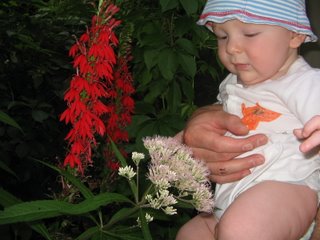
Swee'pea's first hard-soled shoes, pictured with goutweed (ugh!), dandelions, forget-me-nots and Sugar D's new birthday shoes.

Friday, April 13, 2007

Horses, Babies and Slackers

I've mentioned before that I used to be big into horses. I went through times when I was very disciplined about it and rode every day in preparation for competitions, and times when I was less ambitious and got distracted by friends and boys (although, in the interest of full disclosure, no real boys were interested in distracting me until I was 17, and then he was passionate about horses too so I remained disciplined so it was more an obsession with boys when I was younger, trying to figure out how to meet some that would like me I guess).

When I was about 14, I got a new horse who was still somewhat green, and I set about training him with the help of my coach. Also at this time, I started babysitting. I discovered that many principles of training horses could be applied to dealing with children. Things like never doubting that you're the boss, never lose your cool, and never get angry. Always keep your eyes on the end goal. Getting angry at a horse, I learned the hard way when I was younger, would set you back weeks in your training. Horses are social animals and their herds have a strict hierarchy that gets renegotiated every time a new horse is introduced. So if a horse thinks they are the boss of you, you are seriously risking your life. Luckily, horses have small brains, and can be relatively easily convinced that you are the boss despite the 1000-pound advantage they have.

Anyways, I babysat people's kids and I applied the same principles that worked on horseback. If the kids screeched for something they couldn't have I remained calm and repeated the options that were available. I negotiated with them. Only once was discipline really called for when a three-year-old pinched her three-month-old baby brother's head so hard the skin wrinkled. Then I did like her parents and sent her to her time-out chair. That same baby brother was somehow already trained to fall asleep by himself. I could put him in his crib awake for his nap and he would coo himself to sleep (AT THREE MONTHS OLD!). I'd have to listen carefully at the end of his nap because he would just sing to himself until I went to get him. I didn't really know how his mother did it but I resolved to do that with my kids one day.

I started to watch other parents over the years and I saw all the mistakes they were making. I resolved not to make those mistakes with my kids.

Well here I am, a parent, and I am making those 'mistakes.' I don't even know how really, but here we are and despite my resolutions that MY child will go to bed, MY child will have a set bedtime, MY child will be put to bed by many different people, and MY child will be babysat by others from time to time, those things haven't really happened. Some things like the bedtime, are coming into place 14 months later, but the babysitting? Not so much. And I do get angry, I do lose my cool.

What I have discovered is that the emotional distance required to train children like horses is impossible when you're the parent. That approach may work fine for two or three-hour periods when you're babysitting someone else's kids and you know you'll be able to walk away when your time is up, but it doesn't work for parents. Or at least it doesn't for me. The high emotions tied up with MY child are further compounded by exhaustion and sleep deprivation, by being so engaged in this motherhood business, so covered in Mommy as Bailey put it on Grey's Anatomy once, that my resources are used up to the last little molecule, so there's nothing left and I STILL have to keep going.

More than anything, I have learned that judging other people's 'mistakes' in parenting are like diagnosing other people's marital problems -- stupid and pointless. We do what works, and at least half of the time, we're coasting on fumes.

Not to mention the fact that I don't think there is a neat and tidy, linear, cause and effect relationship between a child's behaviour and parenting choices. It's a complex interplay between nature and nurture, which in turn is a negotiation between the natures and nurtured experiences of two different parents (if they're both involved). For example, Andrea mentioned in a comment at B&P's that Frances hasn't had a temper tantrum - ever - and she's three. Does Andrea know the secret of parenting that none of the rest of us know? Or is she just lucky? With all due respect to Andrea, I have to believe she's lucky.

I just read confessions of a slacker mom by muffy mead-ferro, who's apparently such a slacker she can't even be bothered with capitalization. I thought it would be right up my alley, since I discovered that I am not a baby trainer. I expected, you know, confessions, from, you know, a slacker. But I got neither. I suppose the pointy-toed shiny black uber-shoes on the cover should have warned me that it wasn't written by a REAL slacker.

On the one hand, it's cool that she's attempting to counteract the plethora of contradictory advice and instructions for new parents, like we here in the blogosphere do from time to time. But on the other, the book mostly just offers yet another contradictory prescription for parents. There are personal anecdotes, which would put the book in a memoir (momoir?) category, but it's also filled with judgments of other parents, including diagnoses of their mistakes, and completely unfounded, unbacked-up conclusions. The prescriptive attitude swiftly removes it from the category of memoir. Alternative titles could have been, "The NEW Right Way to Parent," or "that's how I was raised and I turned out fine."

I am not a person who trusts science just because it's science, but if you're going to draw a conclusion like if your kid throws a tantrum in a store, you should march the child out explaining that not only will you not buy the kid the airplane he's freaking out over but you won't even let him be in the store, I'd like to see some kind of evidence that it'll work. Muffy says that the momentary inconvenience of not completing your errand will pay off later, but doesn't offer the slightest bit of proof that it actually works, whether anecdotal or study-based. That is not a slacker mom, in my opinion. A slacker mom would do what works in the moment, which probably means accomplishing the errand however you can.

PLUS, that whole little anecdote she used was about somebody ELSE's kid having a temper tantrum in a store. And she thought she knew what the right course of action was? For someone ELSE's kid? I don't buy it.

Some of what muffy says I happen to agree with. Like encouraging more unstructured time and not packing the calendar too full of structured activities. And as B&P once called it, a little benign neglect is not such a bad thing, in my opinion. And, I'm also not into buying a boatload of toys... I love watching Swee'pea's endless fascination for a yogurt container, putting the lid on and off, and putting items in the container then taking them out. I like that he plays with lots of stuff other than toys and if we're in a new place he gets new containers from the kitchener cupboard.

But muffy uses a lot of examples from her own childhood being raised on a cattle ranch in Wyoming. (I will come back to my suspicion of parents who don't examine their own parents' choices with a critical eye in another post.) She argues that it's a good thing to let children learn for themselves to avoid making stupid mistakes that hurt, to learn that they should be careful of cracks in the sidewalk because scraped knees hurt. Which doesn't sound so bad, but her illustration comes from the ranch. I grew up on a farm too, not a working farm but we still had to take the hay in on the hottest days of the year, and it was also just about to rain so we had to work as hard and as fast as we could. I drove the truck once when I was about 12 years old because we were shorthanded and I wasn't strong enough to throw the bales on the back of the truck.

Anyways, my point is that farms are unsafe for kids. Children die or suffer serious injuries on farms every year. Which is not to say that it's bad to raise kids on a farm or involve them in chores, but just that the fact that many children survive their childhoods without serious injury doesn't mean that it's a paragon of childrearing. It doesn't mean we should let our kids figure out how to avoid stupid mistakes that endanger their lives without our guidance. Yes, we can't protect our kids from every possible injury, but we may as well protect them from the ones we can.

(I remember once my first boyfriend and I went for a walk to a local swimming hole one night. There was heat lightning in the sky while we were swimming, and on the walk back it turned into a bonafide thunder storm. I freaked. I just knew we were going to fry. I was frozen in place and hyperventilating. My legs wouldn't work. But my boyfriend said that maybe we were going to get struck, but he was determined that he would be as close to home as he could damn well get before it happened. So I got my legs back and we ran the mile home holding hands and arrived safely. I think about his attitude a lot when faced with a difficult situation.)

Muffy even trots out the old horse-child analogy that made so much sense to me before I was a parent. The analogy grossly oversimplifies the tension of trying to sort out what limits to enforce when, trying to sort out when it's right to be the boss and when it's right to encourage a sense of agency in our children. And trying to sort out when it's right just to surrender for the sake of our own sanity and survival. Never mind that these limits are going to be different from family to family.

Muffy tries to end the book with a chapter about how we must follow our own instincts and never mind the parenting manuals, which is obviously an idea close to my own heart. But it falls flat after the previous 8 or whatever chapters prescribing the RIGHT way to parent.

So I guess I'm encouraged that there's room in the market for a book by a REAL slacker like me, with REAL confessions, not rationalizations and judgments. I think there is far more power in writing about our own experiences as parents without extrapolating them to other people. I think it's better to look at the kid throwing a temper tantrum in the store with some interest in what the parent does, not for judgment or to compare what the parents do with the RIGHT way to respond, but to learn how to suspend judgment and be more sympathetic. Our lessons and methods don't have to be used by other people to be right. I think it is far more subversive and supportive to embrace plurality and difference in our parenting choices than it is to add yet more voices and opinions and contradictions to the chorus of the ONE RIGHT WAY to parent.